The complete field guide
Understand fishing from water to hook.
A broad international guide to fish behaviour, habitats, equipment, rigs, techniques, watercraft, safe handling, governance and responsible angling.
By RodRookies · Independent fishing guide from the Netherlands · Updated 21 August 2026
Explore every chapterAffiliate notice: RodRookies may earn from qualifying purchases through clearly labelled affiliate links, at no extra cost to you.
Contents
Learn in a useful order
Fish and water
Biology, habitat, season, temperature, oxygen, structure and feeding behaviour.
Open chapterEquipment and rigs
Rods, reels, drag, line, leaders, knots, hooks, terminal tackle, bait and lures.
Open chapterMethods and watercraft
Major techniques, locating fish, presentation, bite detection, fighting and landing.
Open chapterSafety and governance
Personal safety, fish care, conservation, legal checks and food safety.
Open chapter01 · Fish biology
Fish follow needs, not maps.
Food, oxygen, temperature, current, depth, light and shelter determine where fish spend time. A productive angler searches for the places where several of these needs overlap.
- Weed edges and reed lines
- Drop-offs and depth changes
- Rocks, wood and man-made structure
- Current seams and slack water
- Shade and temperature breaks
- Baitfish, insects and bird activity
- Spawning and seasonal movement
- Water clarity and dissolved oxygen
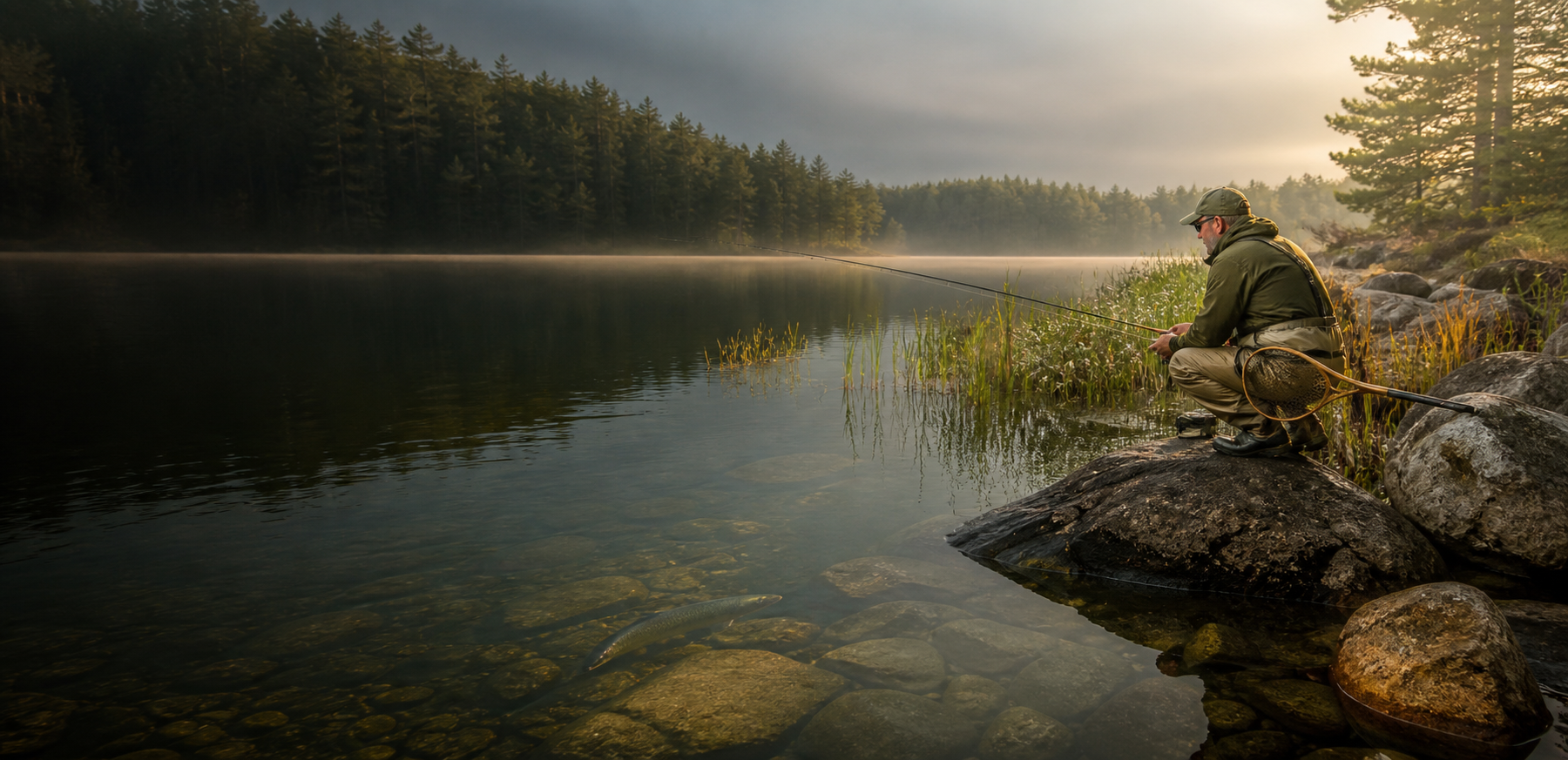
02 · Read the water
Look for edges and change.
Fish rarely distribute evenly. Current, wind and structure concentrate food and create resting or ambush positions.
Observe before casting. Then cover water methodically and change only one variable—depth, speed, colour, size or location—at a time.
03 · The tackle system
Every component must work together
Rods
Length controls leverage and casting space. Power describes the load range; action describes where the blank bends. Match both to lure or sinker weight and target fish.
Reels and drag
Spinning reels are easiest for general use. Baitcasting rewards control, conventional reels manage heavy work and fly reels support a distinct casting system.
Lines and leaders
Monofilament is forgiving, braid is thin and sensitive, and fluorocarbon is widely used for abrasion-resistant leaders. Diameter and condition matter as much as the printed strength.
Hooks and terminal tackle
Hook style, size, weight, float, swivel and leader should present the bait naturally while supporting reliable bite detection and safe landing.
04 · Bait, lures and knots
Presentation turns tackle into fishing
Natural and prepared bait
Often effective and intuitive, but freshness, storage, hook placement and local bait restrictions matter.
Artificial lures
Choose size, profile, depth, action, colour and retrieval speed to suit prey, visibility and fish activity.
Reliable connections
Learn one terminal knot, one line-to-leader knot and a loop knot where extra lure movement helps. Wet, tighten and test every knot.
05 · Major techniques
Different methods solve different water
Spinning and lure fishing
Cast and retrieve while varying depth, speed and action. Excellent for active searching and predator fishing.
Float fishing
Suspend bait at a controlled depth and use the float as both presentation tool and bite indicator.
Feeder and bottom fishing
Present bait near the bed, sometimes with feed delivered close to the hook. Balance holding power with sensitivity.
Fly fishing
The weighted fly line carries a light fly. Casting, line control, presentation and prey imitation form one specialised system.
Carp fishing
Often uses bottom rigs, careful feeding, rod rests and bite indication. Strong landing and unhooking equipment is essential.
Surf and sea bottom fishing
Longer rods and heavier sinkers reach or hold water beyond breakers. Tide, current and exposed-shore safety shape every decision.
Trolling
Move lures or bait behind a boat while controlling speed, depth, spread and safe navigation.
Topwater fishing
Surface lures create visible strikes. Timing, pause, rhythm and restraint after a strike are important skills.
06 · Finding and catching
Build a repeatable decision loop.
- Observe weather, water and visible life.
- Choose structure or a depth zone.
- Select a presentation that reaches it.
- Make controlled, repeatable casts.
- Change one variable at a time.
- Record the pattern that produces interest.
07 · Fight, land and release
Control protects both tackle and fish
Set the drag
Use steady pressure while allowing controlled line release during strong surges. Avoid locking a light system.
Prepare the landing
Ready the net and tools before the fish arrives. Clear nearby line, rocks and other hazards.
Handle deliberately
Wet hands, support the body, keep air exposure brief and return the fish with care when release is legal and appropriate.
08 · Safety, law and sustainability
The guide is not complete without responsibility
Personal safety
Check weather, tide, access and daylight. Use eye protection, grippy footwear and an appropriate PFD near deep, cold, moving or open water.
Local rules
There is no universal international licence. Verify the exact official authority for access, seasons, legal methods, protected species and catch limits.
Conservation
Use suitable tackle, minimize fight time, prevent litter and line loss, avoid damaging spawning or sensitive habitat and report invasive species where required.
Food safety
Identify species correctly and follow official contamination, handling and consumption guidance. If uncertain, do not eat the catch.
09 · Troubleshooting
Common problems, useful first checks
No bites
Change location or depth before buying new tackle. Then adjust presentation speed, size, colour or bait freshness.
Line tangles
Check spool fill, line twist, wind knots, damaged guides and the match between lure weight, line and rod.
Fish coming off
Inspect hook sharpness, drag setting, knot quality, rod pressure and whether the hook pattern suits the method.
Too much equipment
Return to one method and one balanced setup. Carry only the tackle needed to vary depth, size and presentation.